Showing posts with label Just Post. Show all posts

13 August 2008

Endangered Species Act Endangered

There's been a lot of rather distressing news flying under the radar as Olympic Games play on. This is just one of them - a move by the United States President to weaken the Endangered Species Act - and it has escaped the notice of most. And since I think it's pretty damn important - and perhaps more in the realm of something I can do something about - I'm reporting it here just in case any of you missed it. Please, if this is an issue you care about and you are a US citizen, write your politicians.

By DINA CAPPIELLO Mon Aug 11, 7:22 PM ET
(AP and Yahoo News) - also reported elsewhere

Parts of the Endangered Species Act may soon be extinct. The Bush administration wants federal agencies to decide for themselves whether highways, dams, mines and other construction projects might harm endangered animals and plants.

New regulations, which don't require the approval of Congress, would reduce the mandatory, independent reviews government scientists have been performing for 35 years, according to a draft first obtained by The Associated Press.

Interior Secretary Dirk Kempthorne said late Monday the changes were needed to ensure that the Endangered Species Act would not be used as a "back door" to regulate the gases blamed for global warming. In May, the polar bear became the first species declared as threatened because of climate change. Warming temperatures are expected to melt the sea ice the bear depends on for survival.

The draft rules would bar federal agencies from assessing the emissions from projects that contribute to global warming and its effect on species and habitats.

"We need to focus our efforts where they will do the most good," Kempthorne said in a news conference organized quickly after AP reported details of the proposal. "It is important to use our time and resources to protect the most vulnerable species. It is not possible to draw a link between greenhouse gas emissions and distant observations of impacts on species."

If approved, the changes would represent the biggest overhaul of endangered species regulations since 1986. They would accomplish through rules what conservative Republicans have been unable to achieve in Congress: ending some environmental reviews that developers and other federal agencies blame for delays and cost increases on many projects.

The chairman of the House Natural Resources Committee, which oversees the Interior Department, said he was "deeply troubled" by the changes.

"This proposed rule ... gives federal agencies an unacceptable degree of discretion to decide whether or not to comply with the Endangered Species Act," said Rep. Nick Rahall, D-W.Va. "Eleventh-hour rulemakings rarely if ever lead to good government."

The new regulations follow a pattern by the Bush administration not to seek input from its scientists. The regulations were drafted by attorneys at both the Interior and Commerce Departments. Scientists with both agencies were first briefed on the proposal last week during a conference call, according to an official who asked not to be identified.

Last month, in similar fashion, the Environmental Protection Agency surprised its scientific experts when it decided it did not want to regulate greenhouse gases under the Clean Air Act.

The rule changes unveiled Monday would apply to any project a federal agency would fund, build or authorize that the agency itself determines is unlikely to harm endangered wildlife and their habitat. Government wildlife experts currently participate in tens of thousands of such reviews each year.

The revisions also would limit which effects can be considered harmful and set a 60-day deadline for wildlife experts to evaluate a project when they are asked to become involved. If no decision is made within 60 days, the project can move ahead.

"If adopted, these changes would seriously weaken the safety net of habitat protections that we have relied upon to protect and recover endangered fish, wildlife and plants for the past 35 years," said John Kostyack, executive director of the National Wildlife Federation's Wildlife Conservation and Global Warming initiative.

Under current law, federal agencies must consult with experts at the Fish and Wildlife Service or the National Marine Fisheries Service to determine whether a project is likely to jeopardize any endangered species or to damage habitat, even if no harm seems likely. This initial review usually results in accommodations that better protect the 1,353 animals and plants in the U.S. listed as threatened or endangered and determines whether a more formal analysis is warranted.

The Interior Department said such consultations are no longer necessary because federal agencies have developed expertise to review their own construction and development projects, according to the 30-page draft obtained by the AP.

"We believe federal action agencies will err on the side of caution in making these determinations," the proposal said.

The director of the Fish and Wildlife Service, Dale Hall, said the changes would help focus expertise on "where we know we don't have a negative effect on the species but where the agency is vulnerable if we don't complete a consultation."

Responding to questions about the process, Hall said, "We will not do anything that leaves the public out of this process."

The new rules were expected to be formally proposed immediately, officials said. They would be subject to a 30-day public comment period before being finalized by the Interior Department. That would give the administration enough time to impose the rules before November's presidential election. A new administration could freeze any pending regulations or reverse them, a process that could take months. Congress could also overturn the rules through legislation, but that could take even longer.

The proposal was drafted largely by attorneys in the general counsel's offices of the Commerce Department's National Oceanic and Atmospheric Administration and the Interior Department, according to an official with the National Marine Fisheries Service, who spoke on condition of anonymity because the plan hadn't yet been circulated publicly. The two agencies' experts were not consulted until last week, the official said.

Between 1998 and 2002, the Fish and Wildlife Service conducted 300,000 consultations. The National Marine Fisheries Service, which evaluates projects affecting marine species, conducts about 1,300 reviews each year.

The reviews have helped safeguard protected species such as bald eagles, Florida panthers and whooping cranes. A federal government handbook from 1998 described the consultations as "some of the most valuable and powerful tools to conserve listed species."

In recent years, however, some federal agencies and private developers have complained that the process results in delays and increased construction costs.

"We have always had concerns with respect to the need for streamlining and making it a more efficient process," said Joe Nelson, a lawyer for the National Endangered Species Act Reform Coalition, a trade group for home builders and the paper and farming industry.

Sen. Barbara Boxer, D-Calif., chairwoman of the Environment and Public Works Committee, called the proposed changes illegal.

"This proposed regulation is another in a continuing stream of proposals to repeal our landmark environmental laws through the back door," she said. "If this proposed regulation had been in place, it would have undermined our ability to protect the bald eagle, the grizzly bear and the gray whale."

The Bush administration and Congress have attempted with mixed success to change the law.

In 2003, the administration imposed similar rules that would have allowed agencies to approve new pesticides and projects to reduce wildfire risks without asking the opinion of government scientists about whether threatened or endangered species and habitats might be affected. The pesticide rule was later overturned in court. The Interior Department, along with the Forest Service, is currently being sued over the rule governing wildfire prevention.

In 2005, the House passed a bill that would have made similar changes to the Endangered Species Act, but the bill died in the Senate.

The sponsor of that bill, then-House Natural Resources chairman Richard Pombo, R-Calif., told the AP Monday that allowing agencies to judge for themselves the effects of a project will not harm species or habitat.

"There is no way they can rubber stamp everything because they will end up in court for every decision," he said.

But internal reviews by the National Marine Fisheries Service and Fish and Wildlife Service concluded that about half the unilateral evaluations by the Forest Service and Bureau of Land Management that determined wildfire prevention projects were unlikely to harm protected species were not legally or scientifically valid.

Those had been permitted under the 2003 rule changes.

"This is the fox guarding the hen house. The interests of agencies will outweigh species protection interests," said Eric Glitzenstein, the attorney representing environmental groups in the lawsuit over the wildfire prevention regulations. "What they are talking about doing is eviscerating the Endangered Species Act."

On the Net:

Fish and Wildlife Service: http://www.fws.gov/endangered

National Marine Fisheries Service: http://www.nmfs.noaa.gov/pr/laws/esa/

National Wildlife Federation: http://www.nwf.org/news

18 July 2008

Tibetan Poetry

Yesterday we had a reading of Tibetan Poets at the bookstore, read by 4 actors. I wanted to share this one with you.

MADE IN CHINA by Tsoltim N Shakabpa
made in china
by unpaid prisoners
made in china
by starving prisoners
made in china
by brainwashed prisoners
made in china
by tortured prisoners
made in china
by dying prisoners
made in china
from dead prisoners
would you buy anything
made in china?


24 January 2008

Last Native Eyak Speaker Dies

I was saddened to learn today that the last native speaker of the Alaskan Native language Eyak died yesterday at age 89. Marie Smith Jones was a tenacious woman, probably the last full blooded Eyak, the last full member of her tribe. She took great pains to try and record her knowledge of the Eyak language so that future generations can resurrect it working with researchers at the University of Alaska and her work brought the problem of language into the public eye. The Eyak people traditionally lived in and around the Copper River Basin, a place where I worked and lived for 5 years, a place that may be known to you for it's famous Copper River Red Salmon which hits the market at top price.

It is sad to know a language has gone extinct and with it all of the cultural beliefs and thought processes and problem solving methods and artistic talent and world views that are unique to the speakers of that language. How lonely Ms. Jones must have felt, not being able to communicate with others in the tongue that she knew best. Some things are just not translatable because they are a concept wholly within the language and not without. This language died in a large part due to the suppression by American authorities of native languages. Ms. Jones was beaten for speaking her language as a child.

I'd like to quote for you what is means for a language to be living (from the Language Log):
there must be little kids who speak the language with each other because it is their only language or else their favorite. Little kids who would speak it even if they were told not to… Ask around the village and find the age of the youngest people using a language every day for all their normal conversational interaction. If the answer is a number larger than 5, the language is probably dying. If the answer is a number larger than 10, it is very probably doomed. If the answer is a number larger than 20, you can kiss it goodbye right now…

Today I hold a candle in my heart for this remarkable woman, Ms. Marie Smith Jones. I hope that Alaskan people pay attention to her passing and to the lessons she has taught us, because unless we act now this will be just the first of many languages that are unique to Alaska to disappear. Hearteningly, the BBC reports, that Nunavut, Canada leads the way in making both Inuktitut and Inuit content management for websites. This means that people can write documents and even pay bills in these native languages through aativk.ca. I truly believe that making modern communications available in these languages will make it more likely for youngsters to use them and for their continuation into the future.

23 January 2008

Energy & GoogleEarth

There's a group of researchers, composing the New Mexico Consortium, trying to put energy knowledge into the public's hands. They are collecting data on all types of energy sources (coal, gasoline, nuclear, oil, wind, solar, geothermal) from public sources and making them into files that can be downloaded and opened in GoogleEarth. Their idea is to put knowledge in the hands of the public so that people can participate in making energy decisions. It allows the public to both download and submit data. For example you could submit your power bill and your power station location and then it could tell you how much of your energy was derived from each of those sources and how much of various waste products it would cost.

This group is both interested in conserving energy and in making it available for all. Currently 3 billion people, almost half the world's population, does not have access to modern energy sources. They don't have lights, or refrigerators, televisions or computers. Imagine that... just for a second.

06 December 2007

Conservation Idea

It seems like one of the biggest challenges in the current energy issues, whether it's oil independence or global warming, is how to get people to use less energy. I think that there is a simple way to get North Americans, at least, to cut down on their energy uses if only I could convince all the planning and zoning committees to agree (we could always tie it to a bill, and say we'll withhold road funding or something if they don't do it...that's how come the legal drinking age is the same across the US).


Water & Electricity cost money. North Americans are notorious for always wanting to "save more" money. However, most North Americans have no clue how much water or electricity they use in a given day. So let's place water & electrical meters by the front door at about nose level where people can see the numbers changing daily. Better yet, make those meters look like your gas pump where next to the consumption level you have the amount of money that consumption costs. If people saw this daily I suspect they would immediately start to reduce their usage. Imagine if every faucet and outlet/light switch had a little meter by it that ran with amounts used and money charged by it? People would start turning off their lights when they left the room, they would stop leaving the water running while they brushed their teeth. Family members would start nagging each other to do these things.

What do you think? Would it work?

16 November 2007

The Spilling of Oil

Okay, I can't stand it anymore (DJ, I am getting to your tag - I promise!) but I have to write about these two ecological disasters occurring right now.


1. The oil spill in San Francisco Bay, USA. This spill was caused when the container ship the Cosco Busan struck the San Francisco Bay Bridge on Wednesday, November 7, 2007 causing 58,000 gallons of bunker fuel oil to dump into the bay. Some 2,000 birds have come into custody (either dead or alive) of the International Bird Research Rescue Center and their counter parts.


2. The oil spill in the Black Sea, Russia. First the oil tanker Volgoneft-139 was split in half by high seas outside the Kerch Strait spilling some 1.3 million tons of oil into the Azov and Black Seas. Second, the sinking of a dry cargo ship near the Port of Kavkaz that was carrying 2000 tons of sulfur. Because ships were being run on the ocean that are outfitted for rivers, ships broke apart in storms and who knows what kind of shape those ships were in. I've been on Russian ships, I can imagine it. Supposedly there were storm warnings but the company CEOs couldn't be bothered to change their plans. You know, who cares if a bunch of seamen die and oil spills during the height of the bird migration. Imagine it...300,000 birds reported dead by the end of the day. The International Fund for Animal Welfare is helping assist Russia assess the impacts.


Photo from the UK Telegraph


Both spills are killing and affecting wildlife. Birds are usually the first hit. Their feathers get oiled and they cease being waterproof. Then the birds get cold and wet and hungry. Sometimes animals eat the oil which then coats their intestines keeping them from getting energy from food or sometimes from swallowing. Next are the fish who get the oil as it sinks. They die because they can't breathe the stuff and it coats their gills. The algae is coated, the mollusks get clogged. In Russia now dolphins are washing up dead on the beach. The effects of these spills will affect these places for a long time to come.


There was a slow response in San Francisco but California has mobilized, they have set up Oiled Wildlife Care Networks, there are organizations trained in the cleanup effort, in Russia soldiers have been mobilized but while they attempt to clean up seamen, who are trying to cleanup the wrecks, are simply pumping fuel into the ocean. I dunno about you but this makes me angry. On Wall Street there are complaints about the rising costs of fuel but they're talking dollars. I'm concerned about the rising ecological costs of fuel. And in case any of you are wondering, the Exxon Valdez has still not paid off all the money it owes Alaskans for the damages to their livelihoods in 1989. In fact they're taking the state to court to try and avoid paying money that is about the equivalent of 5% of their quarter earnings. Yeah, that's right, they're willing to spend more money to fight us in court rather then do the responsible thing.

(Note: I am not quoting my sources because they would be too many but clearly this is not first hand information but from various news sources combined with some background info from my own participation in cleaning up 3 oil spills.)

11 September 2007

Hosting Oct Scientiae Carnival (& a blurb on Just Posts)

CALLING ALL SCIENTISTS, TECHNOCRATS, ENGINEERS, & MATHEMATICIANS!!!! I have volunteered to host the October 1, 2007 Scientiae Carnival (click here or on the button to the right), a blog carnival that compiles posts written about the broad topic of "women in science, technology, engineering and mathematics (STEM). Anyone may contribute as long as the topics are "relevant & respectful" (for more details check out the Scientiae Welcome Page). Please pass the word on to your fellow scientists, technocrats, engineers, and mathematicians! SEPTEMBER's Scientiae Carnival can be found over at Suzanne E Frank's @ Thus Spake Zuska.

THE OCTOBER THEME: Mentoring/ Supervising/ Advising - the good, the bad, the inspiring, and the morale draining. Details about relationships you've had on either side of the boss/employee, advisor/student relationship. What kind of people inspired you and kept you going? What were the qualities that you admire in such people? What kind of people made you want to throw the towel in, made you feel incompetent and feel like you would never make it in the field? What kind of qualities were these? And most of all, how do we as a community of women scientists, be good mentors for the others? Any memories of someone who just inspired you? What are our responsibilities as mentors? As good supervisors? As employees/ students? Do tell!

SUBMISSION: Please submit your posts (or posts by others that you think qualify) by the usual methods, and try to get them in by 8 am Alaskan Standard Time (that's 12 pm Eastern Standard Time) on September 31st. I will get it up on the 1st or 2nd of October.

IN OTHER NEWS: Jen @ One Plus Two, Mad @ Under the Mad Hat, Hel @ Truth Cycles, and Susanne @ Creative Mother Thinking have just posted the August lists of Just Posts or Posts for Justice (they sum up posts at the end of the month while Scientiae sums them up at the begining, in case you were wondering). Go check them out (click on the button to go there now)!

21 August 2007

What we can do

So I thought that after that last post I should post some resources on what we can do to slow/ control climate change. It may seem like a small drop in the bucket, each of us working on our own behaviors, but I am reminded of my favorite West African saying "If you think you are too small to make a difference, remember what it is like to sleep in a room with a single mosquito."

Girls for Glaciers (http://girlsforglaciers.wordpress.com/) is a blog about two girls trying to change their habits to be more globally friendly. It's an excellent place for those who don't know where to start. For more ideas check out the Environmental Defense webpage (http://www.fightglobalwarming.com/index.cfm?source=banner_search). Here you can find out which machine is the most environmentally friendly before you buy and you can even sign up for weekly email tips. Check out the Global Footprint Network, Advancing the Science of Sustainability (http://www.footprintnetwork.org/) to learn about new technologies working towards a better planet. And finally, don't forget to estimate your global footprint (http://www.earthday.net/Footprint/index.asp) to find out your personal impact on the planet and to help your resolve to do better!

16 August 2007

The Changing Alaskan Arctic/ Sub-Arctic

Warning, I'm going to get on my soapbox a little here. People ask me all the time if I've noticed the effects of climate change in the north. I have. As a scientist I have seen reams of data from various colleagues that all show the same worrying trends. I am not going to talk about data or figures here though, I want to present my personal observations about the changes that have occurred in the time that I have lived in Alaska. In the last seven years folks. The arctic is sort of the bell weather of change but I know that changes like this are happening all over the world in your communities too - all the "unusual" & "record setting" weather is just one example. Dispersed in between my observations will be photos (taken from the air) of icebergs and glaciers that I have the privilege to experience in my landscape that are melting away - I want to share with you the beauty of this ice, especially if you have never seen it before and as it is particularly vulnerable to climate change. And a quick note: I will not be replying to comments that demand that this isn't happening, I mean come on, even the current US president Dubya has finally admitted it is. If you believe there is no change or that the degree of change is natural arguing with you is like arguing with a believer over some sacredly held interpretation of text; it's pointless. I will however, address thoughtful questions.


Permafrost is melting. This is causing houses to sink and tilt into the landscape, causing bike paths & roads that were once even surfaces to bump up. It is causing lakes to disappear (through a process called thermakarst). Ironically, the ice roads that oil companies use to access their wells are melting meaning they can use them less and less time out of the year.


Lakes & wetlands are disappearing both because of thermakarst & because of increased air temperatures.


As lakes & wetlands disappear they fill in with shrubs and trees. The habitats of wild things that like marshy land shrinks. More lakes freeze solid in the winter as they are shallower. This means less fish stock (including the economically valuable salmon) is surviving the winter which means there are less fish in the oceans.


The ice is melting. Glaciers are melting for multiple reasons. As the temperature of sea water has raised a degree the are melting faster where they meet the ocean, with increased heat in the atmosphere more of them is evaporating into the air, with increased rain caused by changing weather patterns they are pooling up more and melting from the top down as well as the bottom up.


Calving glacier melting is causing changes in water temperature and availability of ice for habitat of ice seals. The bergs are lasting less and less long into the season, the calving occurs with greater frequency.


Glacier melting and warmer temperatures have increased the shrub & tree lines in the arctic. Whole landscapes and views that once existed have disappeared.


Increased fires in interior Alaska have led to a decrease in trees and an increase in heat loss to the atmosphere and a reduction in CO2 recycling by plants and an increase in smoky skies which affect living quality.


Bug infestations such as birch bark beetle and leaf miner which used to cycle every ten years have now been heavy for three years running in interior Alaska causing these trees to be drier and more susceptible to flame. Between flame & bugs the lowlands of Alaska may become grassland while the uplands become shrubby.

Changing winds have increased the impact of mosquitoes on caribou & reindeer on the north slope as these animals are finding less and less relief. More die from insect harassment and from the energy required to keep moving to keep them off.


The ocean is rising. Arctic villages are sinking into the waves and are having to be pulled back from the edges.


The oceans are not freezing as completely or as securely to the shore. Fast ice, which allows both polar bears and people to get out on the ice is disappearing stranding polar bears on land causing an increase in bear/ human conflict.


The rivers are not freezing as completely for as long. Rivers are the traditional method of getting around bush Alaska and the time that they are unstable - where you can not dog mush, snow machine, or boat on them - is increasing making communities more isolated.


Snow is not what it used to be. It falls later, it melts earlier. If you question this note that the last 3 years the famous Iditarod sled dog race re-start location has had to be moved north from it's traditional location as there is not enough snow.


Parasites are showing up in Alaskan wild animals that have never been seen in Alaska before.


The arctic is the place where change is happening fastest. Look around you, every where people are saying "This is really abnormal weather" or "Record year for this (fill in the blank with the weather in your area)". This is happening everywhere the world over. The climate is changing folks. And it is our habits that are doing it.


Note: I do not use "global warming" as I feel this term is both mis-leading and a political salve. People feel better if you talk about warming, they feel they wouldn't mind if it warmed. But the truth is that it is global change which exacerbates all climate patterns. It makes the cold colder in the winter, the hot hotter in the summer, the dryness dryer, the wetness wetter, and the storms bigger and more unpredictable. The US administration which has belatedly admitted that climate change is happening would prefer us to use warming because warming sounds milder. It lulls us and keeps us from acting - words are power and how we describe something can take or give strength to it.

13 August 2007

Working Against Cultural Bigotry

It is International Blog Against Racism Week and since cultural and religious based bigotry often coincide with racism and the week coincides with the arrival of the AFS exchange students to Alaska I thought I would share with you why I am proud to be a volunteer with this organization and why I think it makes a difference.

AFS is an intercultural, non-governmental organization that promotes intercultural learning through worldwide exchange programs for students, adults, and families. AFS flies no single flag, represents no single ideology or national objective, and speaks no single language. It was founded by volunteer ambulance driver's in World War I who thought that if people knew each other and had a better understanding of each other's cultures there would be less need to go to war. It is now the oldest exchange program in the world and is still run primarily by volunteers.

"AFS enables people to act as responsible, global citizens working for peace and understanding in a diverse world. It acknowledges that peace is a dynamic concept threatened by injustice, inequality, and intolerance.

AFS seeks to affirm faith in the dignity and worth of every human being and of all nations and cultures. It encourages respect for human rights and fundamental freedoms without distinction as to race, sex, language, religion, or social status."


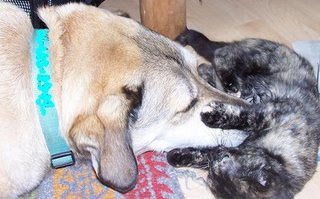
My Dog & Cat in inter-species communication


One of the things that makes me very proud of AFS is the organizations reaction to the 9/11 World Trade Center attacks. This event showed AFS-USA that there is clearly a huge rift of understanding between Muslim & Judeo-Christian cultural groups and nations. We discussed how can AFS increase understanding between these groups? We decided to create a scholarship particularly aimed at exchanging students & teachers between nations that are predominantly one or the other, in other words, encourage non-Muslims to go on exchange to Muslim based nations and non-Judeo-Christians to go on exchange to Judeo-Christian based nations. These students will learn amazing things about the other cultures and their own but more importantly is that they will connect with people and when they return to their home countries they will share those connections with their communities. These connections make it harder to generalize and scapegoat the group because the group has a face and a name and a history.